Clear, sourced answers about the new powerlines, who they serve, who pays for them, and where state officials stand.
What are the 765-kV powerlines in Texas?
They are 765,000-volt transmission lines—the first lines this powerful ever built on the main ERCOT Texas grid. In 2025, the Public Utility Commission (PUC) selected 765-kV lines for the Permian Basin Reliability Plan based on their interpretation of House Bill 5066. In December 2025, ERCOT's board approved the rest of its 765-kV Strategic Transmission Expansion Plan (STEP), extending those lines into a Western Loop and an Eastern Backbone. Together, STEP and the Permian plan call for 14 new 765-kV lines. The commission approved the first two on August 28, 2026, and a third on September 11.
Sources: T&D World · ERCOT · ERCOT · HPPR / Texas Tribune
Which Texas counties could the 765-kV lines cross?
Andrews, Atascosa, Bandera, Bell, Bexar, Borden, Bosque, Brown, Burnet, Callahan, Coke, Coleman, Comanche, Concho, Coryell, Crane, Crockett, Culberson, Eastland, Ector, Edwards, Erath, Glasscock, Hamilton, Hood, Howard, Irion, Jones, Kerr, Kinney, Lampasas, Llano, Loving, Martin, Mason, McCulloch, Medina, Menard, Midland, Milam, Mills, Mitchell, Nolan, Pecos, Reagan, Real, Reeves, Runnels, San Saba, Schleicher, Shackelford, Somervell, Stephens, Sterling, Sutton, Taylor, Terrell, Tom Green, Upton, Uvalde, Val Verde, Ward, Williamson and Winkler.
See the route map →Sources: Public Utility Commission of Texas · Oncor · Public Utility Commission of Texas · Office of the Texas Attorney General · Oncor
Which utilities are building the 765-kV lines?
Oncor is building the two northern lines approved on August 28, 2026. AEP Texas and CPS Energy, San Antonio's city-owned utility, hold the Howard–Solstice line approved on September 11 (PUC Docket 59336). Oncor and LCRA are seeking approval for the Bell County East–Big Hill line (PUC Docket 59475). Two more lines are still at the open-house stage: CenterPoint Energy and AEP Texas are jointly planning Hillje–Blu Lacy, and AEP Texas and CPS Energy are planning Blu Lacy–Howard, with AEP Texas building the southern half and CPS Energy the northern half. AEP Texas expects to file for PUC approval of Blu Lacy–Howard in early 2027. Utilities earn a fixed rate of return on what they spend building these lines, paid through electric bills. At a September 30, 2026 Senate hearing, the PUC put Texas utilities' average allowed return on equity at about 9.6%. That is more than the roughly 7% investors expect from the stock market as a whole, even though regulated utilities are far less risky. Mark Ellis, who handled cost of capital at Oncor's majority owner Sempra and testified at the same hearing, estimates a fair return at 6 to 6.5%.
Sources: HPPR / Texas Tribune · Public Utility Commission of Texas · LCRA · CenterPoint Energy · AEP Texas · Texas Energy and Power
Who are the 765-kV lines being built for?
ERCOT planned for 26,400 megawatts of Permian Basin electric demand by 2038. Of the 11,695 MW of new non-oil-and-gas demand, about 59% is crypto mining, 22% is hydrogen, 13% is other industry, and 6% is data centers. The crypto share alone is enough power for about 1.7 million homes. The rest of the projected demand is oil and gas operations, which ERCOT counts together with homes and local businesses. Since then, the story has kept changing. By late 2025, ERCOT was pointing to data centers first, ahead of hydrogen and crypto mining, to justify the full 765-kV plan, and to about 50,000 MW of new large-load demand statewide by 2030. Crypto mines or data centers, it's clear these lines aren't being built for normal Texans.
Sources: ERCOT · ERCOT · ERCOT · ERCOT
Why 765-kV lines instead of the usual 345-kV?
765-kV lines carry far more power than the 345-kV lines that are standard on the Texas grid, so fewer of them are needed. The PUC said that could reduce impacts on landowners and landscapes. The tradeoff is cost: estimates put the 765-kV option at about 22% more than the lower-voltage alternative.
Sources: T&D World · HPPR / Texas Tribune
Who pays for the 765-kV lines?
Everyday Texas households and businesses. State utility rules spread the cost of large transmission lines across every electric bill on the ERCOT grid. NRG Energy estimates the 765-kV plan could add more than $200 a year to an average household bill. Transmission utilities earn a regulated rate of return on what they spend building them. Meanwhile, large industrial users that can shut down during a few peak hours—like crypto miners and data centers—can avoid most transmission fees, a benefit ordinary households don't receive.
Sources: Public Utility Commission of Texas · NRG Energy · Texas Energy and Power
How much will the 765-kV lines raise my electric bill?
NRG Energy estimates the full 765-kV plan, about $33 billion, would add more than $200 a year to a typical household's bill. Depending on your utility, that's $178 to $268 a year, raising the transmission and delivery part of the average residential bill by 24% to 32%, unless the PUC changes how transmission costs are split between households and big industrial users. That comes on top of increases already underway: ERCOT's wholesale transmission rate rose 116% from 2013 to 2025. Utilities pass those costs directly to ratepayers.
Sources: NRG Energy
How much do the 765-kV lines cost?
The Permian Basin lines are expected to cost nearly $14 billion, and ERCOT has proposed more than $18 billion in additional 765-kV lines in the eastern half of the state, about $33 billion in all. The Texas Public Policy Foundation estimates these projects could add more than $3 billion a year in transmission charges in the 2030s. Big lines often run over budget: Texas's CREZ wind lines grew from about $4.9 billion when approved to $6.8 billion when finished.
Sources: Utility Dive · ERCOT · Texas Public Policy Foundation · Texas Tribune
What happens next with the 765-kV lines?
The PUC approved Oncor's two northern lines on August 28, 2026, and the Howard–Solstice line on September 11, telling the utilities to work with landowners on route changes. The same day, it sent two other proposals back to administrative judges. Approval lets utilities start acquiring easements, surveying and building. Lt. Gov. Dan Patrick and Sen. Charles Schwertner want the Legislature to review transmission policy when it meets in 2027.
Sources: HPPR / Texas Tribune · Texas Tribune (via San Antonio Current) · HPPR / Texas Tribune
Can a utility take my land for a 765-kV line?
Once the PUC approves a line, the utility can begin obtaining easements along the route, and property can be condemned by entities authorized by law. Under the Texas Landowner's Bill of Rights, you're entitled to adequate compensation, a written appraisal from a certified appraiser, and a good-faith offer before any condemnation lawsuit. You can hire your own appraiser and attorney, and report misconduct by a right-of-way agent to the Texas Real Estate Commission.
Sources: HPPR / Texas Tribune · Office of the Texas Attorney General (published by LCRA)
How tall are the 765-kV towers, and how wide is the easement?
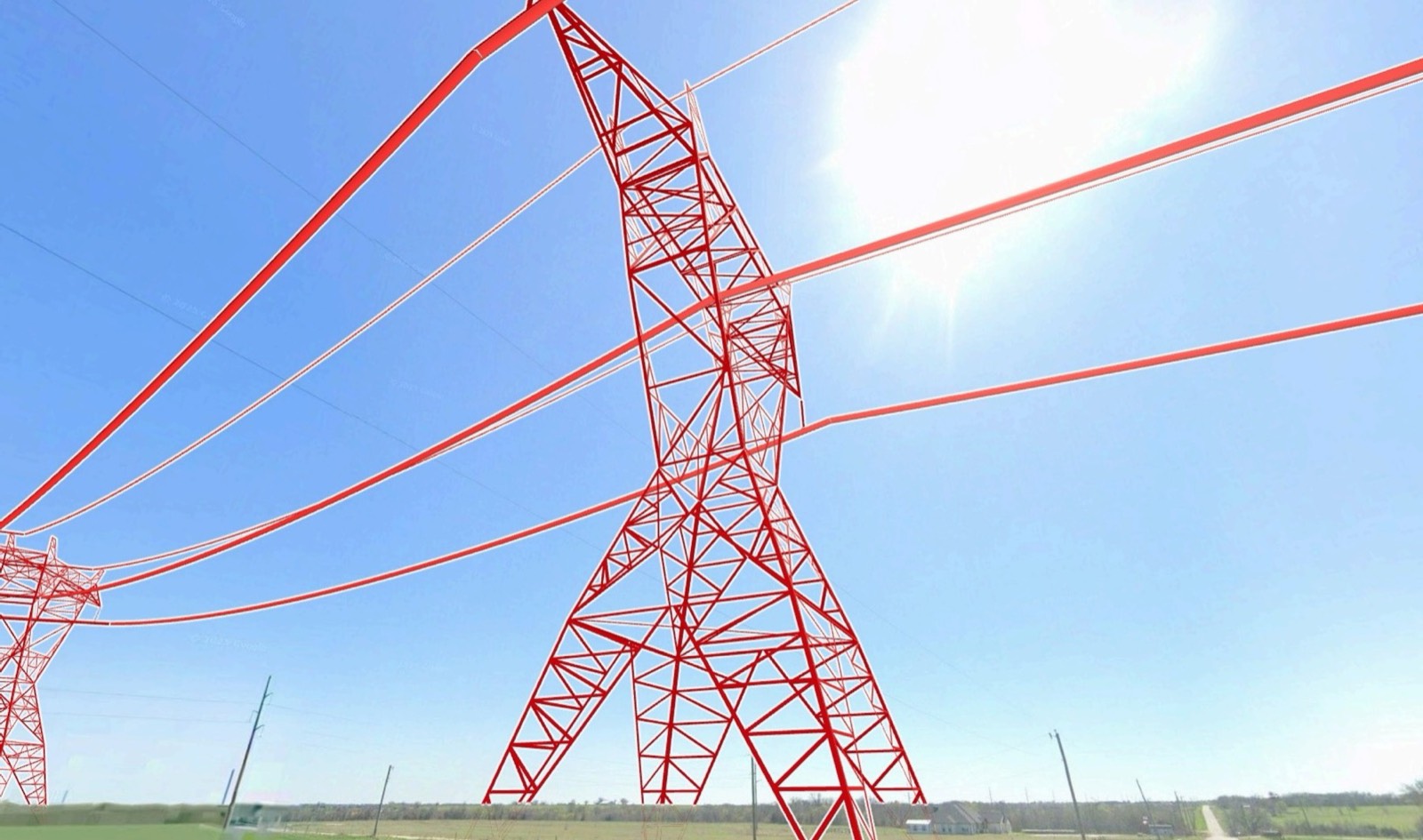
Most towers will stand about 140 to 160 feet tall, roughly as tall as a 15-story building, on a permanent right-of-way about 200 feet wide. AEP says its towers will typically be spaced about 1,400 feet apart. Oncor's testimony puts its typical height at 155–160 feet, with some towers up to 198 feet.
Sources: CPS Energy and AEP Texas · Dallas Morning News · Stop This Line
How close can a 765-kV line come to my house?
Texas has no fixed minimum distance. When the PUC compares possible routes, it counts how many homes, schools, churches and businesses sit within 500 feet of each route's centerline, and weighs that against cost and length. A route close to more homes scores worse, but it can still be chosen.
Sources: Public Utility Commission of Texas
Will I be able to hear a 765-kV line?
Possibly, especially in rain or fog. Very high-voltage lines make a hissing or crackling sound called "corona noise." It gets louder in wet weather and fades with distance. A federal study of a 500-kV line measured about 47 decibels at the edge of the right-of-way in bad weather, and an older review of 765-kV lines said the noise could bother some people within about 750 feet.
Sources: Bonneville Power Administration · U.S. Department of Energy (OSTI)
How strong are the magnetic fields near a 765-kV line?
It depends on how much power the line carries, which changes through the day and the year. Federal environmental studies found fields from under a few milligauss up to 300 milligauss or more right next to heavily loaded 230- to 765-kV lines, dropping quickly with distance. Utilities can model expected levels for a specific route, and landowners can ask for numbers at the edge of the right-of-way and at 100, 300 and 500 feet.
Sources: Bonneville Power Administration
Are 765-kV powerlines a health risk?
The science is unsettled. In 2002, the International Agency for Research on Cancer classified the magnetic fields from power lines as "possibly carcinogenic to humans," based mainly on studies of childhood leukemia. The World Health Organization concluded that this evidence "is not strong enough to be considered causal," and found no substantive health issues from the electric fields people normally encounter.
Sources: International Agency for Research on Cancer · World Health Organization
Will a 765-kV line hurt my property value?
It depends on how close the line is and what kind of land it crosses. For private homes, a review in the Journal of Real Estate Literature found property value losses up to 10%. Rural land could be affected as much as 20%.
Sources: Journal of Real Estate Literature · Headwaters Economics
When will construction on the 765-kV lines start?
Oncor plans to finish the Dinosaur–Longshore line in 2028 and Longshore–Drill Hole in 2029. There's no published schedule yet for Howard–Solstice, and no public construction start dates for any line. Legal challenges could cause delays.
Sources: Oncor · Oncor
What is Greg Abbott's connection to crypto mining?
Abbott's campaign began accepting Bitcoin donations in 2014. In June 2021, he signed legislation to help grow the blockchain industry in Texas, and that October he publicly stated Texas "will be #1 for blockchain & cryptocurrency." He promoted bitcoin miners as a flexible electric load that could turn down consumption during grid emergencies.
Sources: Texas Tribune · Texas Tribune · Gizmodo
Did crypto miners profit off the August 2023 heat wave?
Yes. While Texans were asked to conserve energy during the intense August 2023 heat wave, bitcoin miner Riot Platforms earned $31.7 million in energy credits: approximately $24.2 million in power-curtailment credits and $7.4 million from ERCOT demand-response programs. Riot later stated it earned about $7 million from ERCOT ancillary services.
Sources: ABC13 Houston · Dallas Express · Riot Platforms
How much have energy companies given Greg Abbott?
About $30 million from oil, gas, and utility interests between 2014 and 2021—roughly 18% of all funds he raised in that period. That included $4.6 million received shortly after the 2021 legislative session that followed Winter Storm Uri. Donors include utilities like Oncor, CenterPoint, Vistra, NextEra, and El Paso Electric. Oncor contributed $100,000 in one recent filing period and is one of the utilities building the 765-kV lines.
Sources: Texas Tribune · KSAT · The Texan · Utility Dive
Who opposes the 765-kV lines?
Landowners and rural residents along the routes have raised concerns over short notice windows and frequently shifting route alignments across private property. On July 31, 2026, Lt. Gov. Dan Patrick and Sen. Charles Schwertner formally asked the PUC to deny all pending applications, and the Texas House held an oversight hearing on data centers and transmission in August. When the PUC approved the first segment anyway, Patrick released a statement saying he was "very disappointed."
Sources: San Saba News · KUT · Texas Tribune · Texas Scorecard
What has Greg Abbott done about data centers?
In June 2026, Abbott instructed the PUC and ERCOT to work to keep data center infrastructure costs off household utility bills. On August 3, 2026, he paused new data center grid connections pending a state audit of up to 300 projects. But it's only a pause: projects that comply with his "standards" can move forward. Within two weeks, Abbott was already announcing data center companies that had committed to comply, and his office says the standards "are being universally implemented by data centers across the state." ERCOT's overall waiting list of large proposed loads includes over 1,800 projects, with data centers accounting for about 90% of them.
Sources: HPPR / Texas Tribune · GV Wire · HPPR / Texas Tribune · Texas Tribune · Office of the Texas Governor
What has Gina Hinojosa said about data centers?
Hinojosa, the Democratic candidate for governor, called on Abbott to place an emergency moratorium on new data center hookups until the Legislature convenes in January, or call a special legislative session. Her plan would give local city and county leaders authority to negotiate terms or reject projects, prohibit developers from hiding water and energy usage behind non-disclosure agreements, and protect household bills from utility rate increases.
Sources: Texas Tribune · El Paso Matters
What has Ken Paxton said about data centers?
Paxton, the Republican candidate for U.S. Senate, describes his support for data center expansion as "a yes with conditions." He emphasizes that data centers bring high-paying technical jobs and economic activity, noting that there is "plenty of open space in Texas" to build them. He now says data centers should pay for their own power infrastructure and supports ending their sales-tax exemption, a tax break he previously voted for while serving in the Texas Legislature.
Sources: Houston Chronicle · Fox 7 Austin
What has James Talarico said about data centers?
Talarico, the Democratic candidate for U.S. Senate, has argued that "data centers are jacking up utility bills across the state of Texas." His platform would require
large industrial users to pay for their own grid infrastructure and connections, eliminate Texas's sales-tax break for data centers, give
local communities authority to approve or deny new facilities, and require water-recycling cooling systems.
Compare the candidates →Sources: Texas Tribune · Fox 7 Austin
When is the 2026 Texas election?
Election Day is
Tuesday, November 3, 2026, with polling locations open from 7 a.m. to 7 p.m. Early voting runs October 19–30. You can check your registration and polling location at
VoteTexas.gov.
Sources: Fox 7 Austin · Texas Secretary of State